
Recent posts:
All about Types Protein Powders
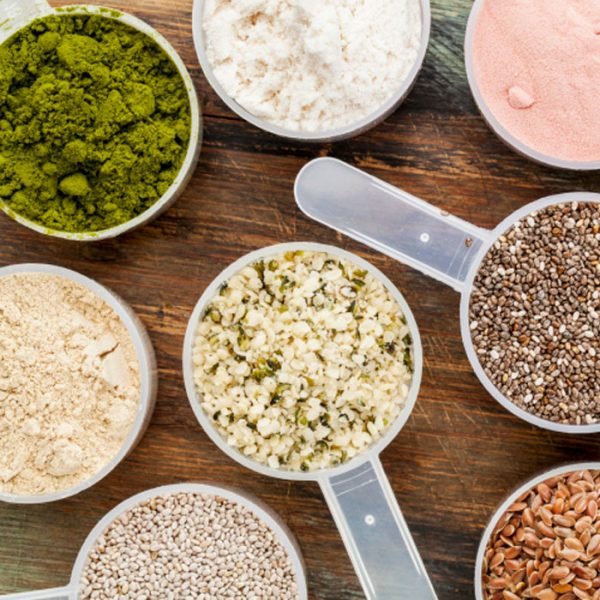
Protein powders Intro
Protein powders can be helpful if you aren’t getting enough protein from whole food, or if you want the convenience and portability of a protein source that won’t spoil easily.How are protein powders made? What’s the difference between types? Read on to find out.
What are protein powders?
Protein powders are dietary supplements that contain a high percentage of protein.
This protein is derived from a variety of different food sources, including:
- Rice
- Egg
- Milk
- Pea
- Hemp
- Soy
- Cranberry
- Artichoke
Along with protein, many manufacturers fortify their products with vitamins, minerals, greens (dehydrated vegetable or other plant products), additional fats, grains, fibre, and/or thickeners. These latter types of products usually contain appreciable amounts of carbohydrates and fat; they’re often considered meal replacement powders (MRPs) instead of straight protein.
Most protein powders are a highly processed food supplement. They must be refined so they don’t taste like garbage and have a long, stable shelf life.
Processing methods
Although protein powders come directly from whole food sources, they’re not whole foods themselves.
They’re created by extracting the protein component of the food, through a variety of processing methods.
Different protein sources require different processing techniques. For instance, as you might imagine, getting rice protein from starch-dense rice takes some maneuvering.
Here are some typical processing methods.
Protein concentrates
Concentration is a high heat drying process and acid extraction to lessen the whole food source into a concentrated protein powder. It’s reasonably priced.
During the processing other impurities can be concentrated with the protein (e.g., lactose, fat, cholesterol).
Concentrates end up being about 60 – 70 percent protein by weight.
Protein isolates
With isolated protein, the idea is to separate out a majority of the protein from the original food. This is accomplished through an alcohol wash, water wash, or ionization technique.
Each method has a different cost. Water is the least expensive and ionization is the most expensive.
After the isolate is created it goes through a filtration process. At this point, virtually everything but the protein has been eliminated. Minimal carbohydrate, fat, fibre and phytochemicals are left.
Isolated protein is about 90 – 95 percent protein by weight.
Protein hydrolysates (hydrolyzed)
Hydrolyzed protein is created by adding water to protein polymers and breaking them into miniature groups of protein called peptides. The groups will range in size from 2 to 5 amino acids.
This is done to enhance absorption. Hydrolysis is essentially pre-digestion.
Hydrolyzed protein is expensive to produce.
Ion-exchange protein
Ions are atoms or molecules containing charge-bearing groups.
Ion exchanging separates protein molecules from other fractions in the food by taking advantage of electrical charges. This is the industry standard for milk protein processing.
Microfiltration, cross microfiltration, ultrafiltration
These are powerful filtration processes that remove contaminants from the concentrated protein component by passage through a membrane. They are similar to the reverse osmosis processes used in water purification.
Why would I want to use a protein powder?
Regardless of your individual goals, it’s important to get enough protein. Protein can help you manage your weight and body composition as well as enhance muscle growth, immune function and exercise recovery.
Protein powders can be helpful if you aren’t getting enough protein from whole food, or if you want the convenience and portability of a protein source that won’t spoil easily.
After all, it’s a lot easier to stick a protein powder package in your gym bag than a chicken breast, and protein powder makes a better fruit smoothie than, say, a steak.
With data from numerous studies demonstrating the importance of protein for both body composition and health, dietary supplements providing protein are some of the most popular supplements available.
What you should know
Most protein powders have strengths and weaknesses.
Rice protein – Hypo-allergenic, gluten-free, neutral taste, economical. 100% plant-based. May be derived from genetically modified rice.
Egg protein – Fat-free, concentrated amounts of essential amino acids. May upset stomach.
Milk protein (includes whey, casein, calcium caseinate, and milk protein blends) – May enhance immunity, high in BCAAs, contains lactose, highly studied. May cause digestive upset or other symptoms in people sensitive to whey, casein, and/or lactose.
Pea protein – No saturated fat or cholesterol, highly digestible, hypo-allergenic, economical. Rich in lysine, arginine and glutamine. 100% plant-based.
Hemp protein – Provides omega-3 fats, most forms provide fibre, free of trypsin inhibitors, can get in raw form, high in arginine and histidine. 100% plant-based.
Soy protein – May have benefits for cardiovascular disease, contains some anti-nutrients, may be derived from genetically modified soy. 100% plant-based.
Cranberry protein – Can maintain antioxidants through processing. Derived from recovered cranberry seeds. Contains omega-3 fats. 100% plant-based.
Artichoke protein – Source of inulin (a prebiotic). Rich in BCAAs. 100% plant based.
Protein quality
Proteins can be classified by their quality. Protein quality is determined by the following methods.
Protein efficiency ratio (PER) is based on the weight gain of a test subject (rats) divided by the intake of a particular food protein during the test period. Previous data was influenced by methionine content. This method determines protein needed for growth and not maintenance.
Net protein utilization (NPU) is the ratio of amino acids converted to proteins to the ratio of amino acids supplied. Another way to think of it is the amount of protein that a food makes available to your body based on digestibility and the amino acid composition. This test is influenced by the essential amino acids in the body and limiting amino acids in the food.
Biological value (BV) is a measure of the proportion of absorbed protein from a food that becomes incorporated into the proteins of the body. Think of it as how well the protein can be used for synthesizing new proteins. Nitrogen retention is monitored. BV does not take into account how the protein is digested and absorbed. It can be altered by recent dietary intake and food preparation.
Protein digestibility corrected amino acid score (PDCAAS) is a method based on the amino acid requirements of young children. It takes into consideration digestibility of the protein. This is a recently developed measure and preferred for determining the quality of protein.
Summary and recommendations
Consider what you hope to accomplish when using a protein powder before making your selection.
Establish digestibility before choosing a protein source. (You may have to experiment.)
The method in which the protein powder is used will also influence your selection (e.g., shakes, puddings, bars, pancakes, etc).
You get what you pay for. By choosing a “cheap” protein powder, you’re likely to get higher amounts of lactose, fat, fillers, and so on not removed during the isolation process.
If you regularly use protein powders, rotating sources every 2-4 weeks may be a helpful guard against building intolerances.
Most protein powders appear to have similar exercise recovery properties. The amino acid content is comparable between sources as well.
References
Anthony JC, et al. Signaling pathways involved in translational control of protein synthesis in skeletal muscle by leucine. J Nutr 2001;131:856S-860S.
Anthony JC, et al. Orally administered leucine stimulates protein synthesis in skeletal muscle of postabsorptive rats in association with increased eIF4F formation. J Nutr 2000;130:139-145.
Ahlborg G, et al. Substrate turnover during prolonged exercise in man. J Clin Invest 1974;53:1080-1090.
Coombes JS, McNaughton LR. Effects of branched-chain amino acid supplementation on serum creatine kinase and lactate dehydrogenase after prolonged exercise. J Sports Med Phys Fitness 2000;40:240-246.
De Palo EF, et al. Plasma lactate, GH and GH-binding protein levels in exercise following BCAA supplementation in athletes. Amino Acids 2001;20:1-11.
FAO/WHO/UNU. Energy and protein requirements. Report of joint FAO/WHO/UNU expert consultation. WHO Tech Pep Ser 1985;724:1-206.
Garlick PJ. The role of leucine in the regulation of protein metabolism. J Nutr. 2005 Jun;135(6 Suppl):1553S-6S. Review.
Harper AE, et al. Branched-chain amino acid metabolism. Annu Rev Nutr 1984;4:409-454.
Layman DK. The role of leucine in weight loss diets and glucose homeostasis. J Nutr 2003;133:261S-267S.
Mero A. Leucine supplementation and intensive training. Sports Med 1999;27:347-358.
Mittleman KD, et al. Branched chain amino acids prolong exercise during heat stress in men and women. Med Sci Sports Exerc 1998;30:83-91.
Patti ME, et al. Bidirectional modulation of insulin action by amino acids. J Clin Invest 1998;101:1519-1529.
Ruberman NB. Muscle amino acid metabolism and gluconeogenesis. Ann Rev Med 1975;26:245-258.
Xu G, et al. Branched-chain amino acids are essential in the regulation of PHAS-I and p70 S6 kinase by pancreatic beta cells. J Biol Chem 1998;273:28178-28184.
All about protein constituents and needs
Dietary protein…it’s one of the most important topics when it comes to your physique and making improvements to it. If you’ve ever wondered what it is, why it’s so important, and how much you should be eating, check out this article.
What are proteins?
Proteins are organic molecules made up of amino acids – the building blocks of life. These amino acids are joined together by chemical bonds and then folded in different ways to create three-dimensional structures that are important to our body’s functioning.
A diagram of protein structures. For more reading on protein structure, check out Madison Technical College’s Lab Manual on Protein Structure.

There are two main categories of amino acids in the body. First, we’ve got essential amino acids – those that the body can’t manufacture, and thus we must consume in our diets.
Some amino acids are conditionally essential, which means that our bodies can’t always make as much as we need (for example, when we’re under stress).
Next, kinda obviously, we’ve got nonessential amino acids – those that the body can usually make for itself.
| Essential amino acids | Conditionally essential amino acids | Nonessential amino acids |
|---|---|---|
|
|
|
Why is it important to get enough protein?
During digestion, the body breaks down the protein we eat into individual amino acids, which contribute to the plasma pool of amino acids. This pool is a storage reserve of amino acids that circulate in the blood.
The amino acid pool in the bloodstream readily trades with the amino acids and proteins in our cells, provides a supply of amino acids as needed, and is continuously replenished. (Think of it like a Vegas buffet of protein for the cells.)
Since our bodies need proteins and amino acids to produce important molecules in our body – like enzymes, hormones, neurotransmitters, and antibodies – without an adequate protein intake, our bodies can’t function well at all.
Protein helps replace worn out cells, transports various substances throughout the body, and aids in growth and repair.
Consuming protein can also increase levels of the hormone glucagon, and glucagon can help to control body fat.1 Glucagon is released when blood sugar levels go down. This causes the liver to break down stored glycogen into glucose for the body.
It can also help to liberate free fatty acids from adipose tissue – another way to get fuel for cells and make that bodyfat do something useful with itself instead of hanging lazily around your midsection!
How much protein do you need?
How much protein you need depends on a few factors, but one of the most important is your activity level.
The basic recommendation for protein intake is 0.8 grams per kilogram (or around 0.36 g per pound) of body mass in untrained, generally healthy adults. For instance, a 150 lb (68 kg) person would consume around 54 grams a day.
However, this amount is only to prevent protein deficiency. It’s not necessarily optimal, particularly for people such as athletes who train regularly and hard.
For people doing high intensity training, protein needs might go up to about 1.4-2.0 g/kg (or around 0.64-0.9 g/lb) of body mass.2 Our hypothetical 150 lb (68 kg) person would thus need about 95-135 g of protein per day.
These suggested protein intakes are what’s necessary for basic protein synthesis (in other words, the creation of new proteins from individual building blocks). The most we need to consume throughout the day for protein synthesis probably isn’t more than 1.4 – 2.0 g/kg.
But wait – there’s more!
Beyond the basics of preventing deficiency and ensuring a baseline of protein synthesis, we may need even more protein in our diets for optimal functioning, including good immune function, metabolism, satiety, weight management and performance.3 In other words, we need a small amount of protein to survive, but we need a lot more to thrive.
We can only store so much protein at one time. As the graph below shows, the body’s protein stores fluctuate over the course of a day. Notice how the upper limit never increases; the amount of protein in the body just cycles up and down as we eat or fast.

Image source: DJ Millward, The Metabolic Basis of Amino Acid Requirements.
The take-home here is that you can’t simply eat a 16-pound steak (a la Homer Simpson consuming “Sirloin A Lot”) once and be done with it. The body needs its protein stores to be continually replenished, which means that you should consume moderate amounts of protein at regular intervals.
Consuming more protein may help maintain an optimal body composition (in other words, help you stay leaner and more muscular) and a strong immune system, good athletic performance, and a healthy metabolism. It may promote satiety (i.e. make you feel full longer) and consequently help you manage your body weight.
Indeed, physique athletes such as bodybuilders have long relied on the rule of 1 gram of protein per pound of body weight – or 150 g per day for a 150 lb individual.
For extra credit
When you eat protein is just as important as how much. After resistance exercise (RE) such as weight training, the body synthesizes proteins for up to 48 hours after training.4
Interestingly, during and immediately after RE, protein breakdown is increased as well. In fact, for a brief period, the rate of breakdown exceeds the rate of building.
The body actually drops into a short-term wasting or catabolic state. However, taking in enough protein during the pre- and post-exercise period can offset catabolism.
The graph below shows that as the blood concentration of essential amino acids (EAA) increases, so too does protein synthesis.

Image source: ABCBodybuilding.com
The graph below shows how amino acid (and amino acid + carbohydrate) consumption after exercise results in a positive muscle protein balance (in other words, helping muscles rebuild, which is a good thing), while the intake of no nutrients can result in a negative muscle protein balance.

Image source: GSSI
Which protein is best? In general it’s your choice – both protein from plant sources and animal sources seem to work equally well in increasing muscle protein synthesis as a result of exercise.5 The amino acid leucine seems to act as a major stimulus for protein synthesis; good sources of leucine include spirulina, soy protein, egg white, milk, fish, poultry, and meat.
Can I eat too much protein?
If you overeat protein, this extra protein can be converted into sugar or fat in the body. However, protein isn’t as easily or quickly converted as carbohydrates or fat, because the thermic effect (the amount of energy require to digest, absorb, transport and store protein) is a lot higher than that of carbohydrates and fat.
While 30% of the protein’s energy goes toward digestion, absorption, and assimilation, only 8% of carbohydrate’s energy and 3% of fat’s energy do the same.
You might have heard the statement that a high protein intake harms the kidneys. This is a myth. In healthy people, normal protein intakes pose little to no health risk. Indeed, even a fairly high protein intake – up to 2.8 g/kg (1.2 g/lb) – does not seem to impair kidney status and renal function in people with healthy kidneys.6 In particular, plant proteins appear to be especially safe.7
Summary and recommendations
- For basic protein synthesis, you don’t need to consume more than 1.4 to 2.0 g/kg (around 0.64-0.9 g/lb) of protein per day.
- Nevertheless, consuming higher levels of protein (upwards of 1g per pound of body weight) may help you feel satisfied after eating as well as maintain a healthy body composition and good immune function.
- You should consume some protein before and after training to ensure adequate recovery.
Endnotes
- Flatt JP 1978; Tappy L, 1996; Blom WA et al., 2006; Latner JD, Schwartz M, 1999.
- Lemon et al 1981; Tarnopolsky et al 1988; Tarnopolsky et al 1991.
- Flatt JP 1978; Tappy L, 1996; Blom WA et al., 2006; Latner JD, Layman et al 2003; Schwartz M, 1999; Tangney CC, et al. 2005; Kishino Y & Moriguchi S 1992; Marcos A, et al 2003.
- Dreyer et al 2006; Koopman et al 2006; Biolo et al 1995; Phillips et al 1997; Norton et al 2006; MacDougall et al 1995.
- Brown et al 2004; Anthony et al 2007; Kalman et al 2007.
- Poortmans JR & Dellalieux O 2000.
- Am Diet Assoc 2003; Millward DJ 1999.
References
American Dietetic Association. Position of the American Dietetic Association and Dietitians of Canada: Vegetarian diets. J Am Diet Assoc 2003;103:748-765.Anthony TG, McDaniel BJ, Knoll P, Bunpo P, Paul GL, McNurlan MA. J Nutr 2007;137:357-362.
Biolo G, Maggi SP, Williams BD, Tipton KD, Wolfe RR. Am J Physiol 1995;268:E514–E520.
Blom WA, Lluch A, Stafleu A, Vinoy S, Holst JJ, Schaafsma G, Hendriks HF. Effect of a high-protein breakfast on the postprandial ghrelin response. Am J Clin Nutr 2006;83:211-220.
Boelens PG, Nijveldt RJ, Houdijk AP, Meijer S, van Leeuwen PS. Glutamine alimentation in catabolic state. J Nutr 2001;131(9 Suppl):2569S-2577S.
Brown EC, DiSilvestro RA, Babaknia A, Devor ST. Nutr J 2004;3:22-27.
Dreyer HC, Fujita S, Cadenas JG, Chinkes DL, Volpi E, Rasmussen BB. J Physiol 2006;576:613-624.
Flatt JP. The biochemistry of energy expenditure. In: Bray GA ed. Recent advances in obesity research. London: Newman, 1978:211–228.
Furst P & Stehle P. What are the essential elements needed for the determination of amino acid requirements in humans? J Nutr 2004;134(6 Suppl):1558S-1565S.
Kalman D, Feldman S, Martinez M, Krieger DR, Tallon MJ. Effect of protein source and resistance training on body composition and sex hormones. JISSN 2007;4:4.
Kishino Y & Moriguchi S. Nutritional factors and cellular immune responses. Nutr Health 1992:8;133-141.
Koopman R, Zorenc AH, Gransier RJ, Cameron-Smith D, van Loon LJ. Am J Physiol Endocrinol Metab 2006;290:1245-1252.
Latner JD & Schwartz M. The effects of a high-carbohydrate, high-protein or balanced lunch on later food intake and hunger ratings. Appetite 1999;33:119–128.
Lemon PW & Nagle FJ. Effects of exercise on protein and amino acid metabolism. Med Sci Sports Exerc 1981;13:141-149.
Lemon PW, Tarnopolsky MA, MacDougall JD, Atkinson SA. Protein requirements and muscle mass/strength changes during intensive training in novice bodybuilders. J Appl Physiol 1992;73:767–75.
MacDougall JD, Gibala MJ, Tarnopolsky MA, MacDonald JR, Interisano SA, Yarasheski KE. Can J Appl Physiol 1995;20:480-486.
Marcos A, Nova E, Montero A. Changes in the immune system are conditioned by nutrition. Eur J Clin Nutr 2003:57 Suppl 1;S66-S69.
Millward DJ. Optimal intakes of protein in the human diet. Proc Nutr Soc 1999;58:403-413.
Norton LE & Layman DK. J Nutr 2006;136:533S-537S.
Phillips SM, Tipton KD, Aarsland A, Wolf SE, Wolfe RR. Am J Phisiol 1997;273:E99–E107.
Reeds PJ. Dispensable and indispensable amino acids for humans. J Nutr 2000;130:1835S-1840S.
Rennie MJ & Tipton KD. Protein and amino acid metabolism during and after exercise and the effects of nutrition. Annu Rev Nutr 2000;20:457-483.
Schwartz MW & Kahn SE. Insulin resistance and obesity. Nature 1999;402:860-861.
Soeters PB, van de Poll MC, van Gemert WG, Dejong CH. Amino acids adequacy in pathophysiological states. J Nutr 2004;134(6 Suppl):1575S-1582S.
Tangney CC, Gustashaw KA, Stefan TM, Sullivan C, Ventrelle J, Filipowski CA, Heffernan AD, Hankins J. A review: which dietary plan is best for your patients seeking weight loss and sustained weight management? Dis Mon 2005:51;284-316.
Tappy L. Thermic effect of food and sympathetic nervous system activity in humans. Reprod Nutr Dev 1996;36:391–397.
Tarnopolsky MA, Atkinson SA, MacDougall JD, Chesley A, Phillips S, Schwarcz HP. Evaluation of protein requirements for trained strength athletes. J Appl Physiol 1992;73:1986-1995.
Tarnopolsky MA, Atkinson Sa, MacDougall JD, Senor BB, Lemon PW, Schwarcz H. Med Sci Sports Exerc 1991;23:326-333.
Todd KS, Butterfield GE, Calloway DH. Nitrogen balance in men with adequate and deficient energy intake at three levels of work. J Nutr 1984;114:2107-2118.
Wu G, Fang YZ, Yang S, Lupton JR, Turner ND. Glutathione metabolism and its implications for health. J Nutr 2004;134:489-492